News

World news Bookmark and Share

18.08.2016 10:49
Indian Regulator Approves Power Start-Up of India's Kudankulam-2
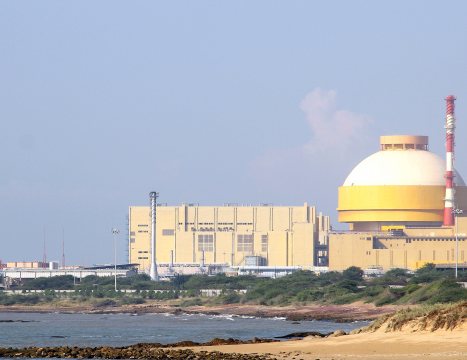
On July 10, 2016, power unit №2 of Kudankulam NPP constructed in India under technical support of ASE Group of Companies, was risen to the minimum controllable power level (MCL)
AUTHOR: publics.bg


  • © Rosatom

On August 16 India's Atomic Energy Regulatory Body (AERB) gave a permit for the power rise of the reactor plant, thus, the Nuclear Power Corporation of India obtained from the atomic regulator the permit for power start-up of Kudankulam NPP second unit, Russian state-owned Atomstroyexport said in a press release.

“Tonight the start of operations for bringing the reactor power unit to the minimum controllable power level is planned, with subsequent loading of the reactor up to the level of 30% of the nominal neutron power”, said Mr. Andrey Lebedev, Vice-president for projects in South Asia of ASE Group of Companies, “The Customer’s planned deadline for connection of Kudankulam NPP second unit to the national Grid is August 27-28, 2016”. The supervisory body believes that the unit may be operated safely.

On July 10, 2016, power unit №2 of Kudankulam NPP constructed in India under technical support of ASE Group of Companies, was risen to the minimum controllable power level (MCL). The beginning of the physical start-up of power unit No. 2 took place on May 11, 2016, when, after performance of all preparatory works, the first fuel assembly was installed in the reactor. In total, 163 fuel assemblies were loaded into the reactor. All the works were performed by Russian and Indian specialist in the mode of automatic operations, in strict compliance with the schedule and safety regulations. The permit for loading was obtained from the supervisory body of India (AERB) after the detailed review of all Safety Reports prepared earlier. On May 19, 2016, the loading of the fresh fuel into the reactor of Kudankulam NPP second unit was successfully completed. The works were performed fully in the automatic mode within the time interval of less than 7 days, 4 days in advance of the schedule. Further the fuel loading was controlled by IAEA inspectors, thereafter the works for the reactor sealing were performed. On June 28 the permit for rising power to MCL was obtained from the Indian regulator AERB. On July 10 the reactor plant was brought to MCL. On July 18 in accordance with deadlines of the Power Unit Commissioning Program, the stage of physical experiments at low levels of power was successfully completed.


TAGS: India | Atomstroyexport | nuclear | Kudankulam | unit 2 | permit | regulation 


All world news

No published comments
Login to comment


Interview

20.03.2022  Teodor Bobochikov, Managing Partner, V-Ridium
Energy Transformation – Trends and drivers
Full text

Events

No records in this category!

Poll

What kind of transport do you use to get to work?


We use cookies to ensure we give you the best browsing experience on our website. Find out more on how we use cookies and how you can change your settings.

Cookies

What are cookies ?

A cookie is a small text file that a website saves on your computer or mobile device when you visit the site. Cookies are widely used in order to make websites work, or work more efficiently, as well as to provide information to the owners of the site.

How do we use cookies?

Website use Google Analytics, a web analytics service provided by Google, Inc. ("Google") to help analyse the use of this website. For this purpose, Google Analytics uses"cookies", which are text files placed on your computer.

The information generated by the cookies about your use of this website - standard internet log information (including your IP address) and visitor behaviour information in an anonymous form - will be transmitted to and stored by Google including on servers in the United States. Google will anonymize the information sent by removing the last octet of your IP address prior to its storage.

According to Google Analytics terms of service, Google will use this information for the purpose of evaluating your use of the website and compiling reports on website activity.

We not use, and not allow any third party to use the statistical analytics tool to track or to collect any personally identifiable information of visitors to this site. Google may transfer the information collected by Google Analytics to third parties where required to do so by law, or where such third parties process the information on Google`s behalf.

According to Google Analytics terms of service, Google will not associate your IP address with any other data held by Google.

You may refuse the use of Google Analytics cookies by downloading and installing Google Analytics Opt-out Browser Add-on. The add-on communicates with the Google Analytics JavaScript (ga.js) to indicate that information about the website visit should not be sent to Google Analytics.

Cookies are also used to record if you have agreed (or not) to our use of cookies on this site, so that you are not asked the question every time you visit the site.

Google Analytics Opt-out Browser Add-on

How to control cookies?

You can control and/or delete cookies as you wish. You can delete all cookies that are already on your computer and you can set most browsers to prevent them from being placed.

All about cookies

Managing cookies in your browser

Most browsers allow you to:
  • see what cookies you have got and delete them on an individual basis
  • block third party cookies
  • block cookies from particular sites
  • block all cookies from being set
  • delete all cookies when you close your browser

If you chose to delete cookies, you should be aware that any preferences will be lost. Also, if you block cookies completely many websites (including ours) will not work properly and webcasts will not work at all. For these reasons, we do not recommend turning cookies off when using our webcasting services.
X
} catch(err) {}