

|

|

Sign up for our newsletter to receive the latest news and information from publics.bg


News
World news


 30.01.2013 13:42
- Siim Kallas, Vice President of the EC in charge of Transport
© European Commission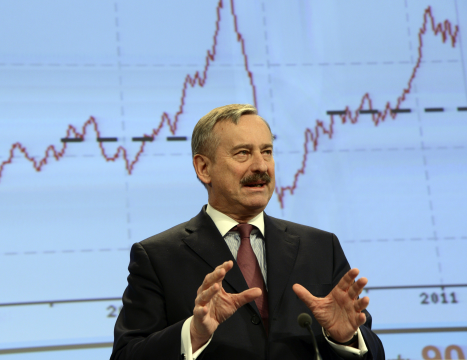
The European Commission has today adopted the 4th Railway Package made up of six legislative proposals focusing on four key areas. To save time and money for companies, trains and rolling stock should be built and certified once to run everywhere in Europe. There should be one safety certificate for companies so they can operate EU wide. To ensure the rail network is run in an efficient and non-discriminatory manner, the Commission is proposing to strengthen infrastructure managers and ensuring that the two functions of managing the tracks and running the trains should be kept apart. To encourage innovation and efficiency, the Commission is proposing to open up domestic passenger railways to new entrants and services efficiency The rail package ensures that Member States can go further to protect staff when public service contracts are transferred.
1) Standards and approvals that works
The Commission wants to cut the administrative costs of rail companies and facilitate the entrance of new operators into the market. Under the new proposals, the European Rail Agency will become a "one stop shop." issuing EU wide vehicle authorisations in the form of "vehicle passports" as well as EU wide safety certificates for operators. Under new arrangements, the ERA will issue vehicle authorisations and safety certificates (in cooperation with the relevant national safety authorities) for RUs on the basis of requests sent to ERA. It will also play an enhanced role in the facilitation of the deployment of ERTMS. Besides these changes, the governance structure and internal operating methods of ERA will be improved. The aim of these measures is to allow a 20% reduction in the time to market for new railway undertakings and a 20% reduction in the cost and duration of the authorisation of rolling stock. Overall, this should lead to a saving for companies of 500 million Euro in 5 years.
2) A Structure that delivers
The new proposals on governance will include key measures to Strengthen infrastructure managers, to ensure that the network is developed in the interests of all players, to strengthen cross-border cooperation between infrastructure managers and separation of managing the tracks and running trains. Under the proposal, institutional separation between infrastructure managers and railway undertakings (without ownership relations between the two types of entity) would become the applicable rule by default from the time of the directive's entry into force. Based on the proposal, it would not be possible any longer to create new holding structures in the rail sector. Rail undertakings, independent of infrastructure managers, will have immediate access to the internal passenger market in 2019. However, the Commission can accept that a vertically integrated or "holding structure" may also deliver the necessary independence, if it puts in place strict "Chinese walls" to ensure the legal, financial and operational separation, including for example: totally distinct decision-making bodies, to prevent discriminatory practices; separate financial flows (with separation of accounts and guarantees to ensure railway undertakings are not benefitting from cross-financing from incomes of the infrastructure manager); separate IT systems to avoid leaking of confidential commercial data; and stringent cooling-off periods for transfer of staff to eliminate conflicts of loyalty. In view of full passenger market opening in 2019, rail undertakings forming part of a vertically integrated structure could be prevented from operating in other Member States if they have not first satisfied the Commission that all safeguards are in place to ensure the legal, financial and operational independence needed to provide a level playing field in practice and to ensure that a fair competition is possible in their home market.
3) Opening domestic passenger markets
There are two ways in which companies will be able to offer domestic rail passenger services across the EU - by offering competing commercial services or through competitive tendering. By bidding for public service rail contracts, which account for some 90% of EU rail journeys, covering in particular most commuter and regional trains, as well as some longer distance ones, and will now be subject to mandatory tendering. (This already happens in some Member States – for example regional services in the German Laender, which the Laender themselves tender, or the UK rail franchise system). Markets for rail freight services have been fully opened to competition since January 2007 and those for international passenger transport services as of 1 January 2010. As a matter of EU law, national domestic passenger markets remain closed, though a few Member States have chosen to allow competition anyway. The opening of rail freight services have had a positive impact, with substantial growth in rail freight in those Member States which have fully respected the spirit as well as the letter of the legal requirements. The opening of the international passenger market has been more problematic, at least in part because the on-going economic crisis is deterring entrepreneurial activity in the sector. National domestic passenger markets remain largely closed. Only Germany, Sweden, Italy, UK, AT, CZ etc. have opened their domestic passenger markets. Experience in these open markets, has shown improvements in quality and availability of services with passenger satisfaction rises year on year and passenger growth in some cases of over 50% over 10 years. Elsewhere, tendering of public service contracts has resulted in savings of 20-30% which can be re-invested to improve services. The Commission is proposing to amend the public service EC Regulation 1370/2007 to make competitive award of public service contracts for rail mandatory and to amend Directive 2012/34/EU to allow general access to run domestic passenger services – but with the possibility to limit access when the economic equilibrium (viability) of a public service contract is compromised. Companies will be able to offer domestic rail passenger services across the EU: either by offering competing commercial services (open access); or through bidding for public service rail contracts, which account for some 90% of EU rail journeys and will now be subject to mandatory tendering. Under the Commission's proposals, competitive tendering will apply only for contracts above certain thresholds.
4) Maintaining a skilled rail workforce
The rail sector in the next decade will face simultaneously the challenges of an ageing working population with the efficiency effects of market opening. Approximately 30% of all rail workers will retire in the next 10 years, probably leading to workforce shortages, while at the same time several RUs may need to be restructured to improve productivity and efficiency. Employment levels after market opening are not expected to decrease, as has been the experience in Member States whose national rail markets are already open. In fact, in the past employment levels have fallen in countries with closed markets. Increased productivity and attractiveness of rail transport will lead to demand increases and investments such as in new rolling stock from which working conditions are likely to benefit.However, the availability of a skilled and highly motivated labour force in the transport sector is essential for the supply of efficient and competitive transport services. For this reason, the Commission is proposing that Pan-European RUs will be required to create European Works Councils, in line with the European Works Council Directive and to take part in the Railway Social Sectoral Dialogue Committee. The Commission is proposing to ensure that Member States can go further to protect workers by requiring new contractors to take them on when public service contracts are transferred, so going beyond the general EU requirements on transfers of undertakings.
 All world news
 Interview
 Full text
 Events


