

|

|

Sign up for our newsletter to receive the latest news and information from publics.bg


News
World news


 26.03.2010 23:30
- Press conference of DB Group
© DB Group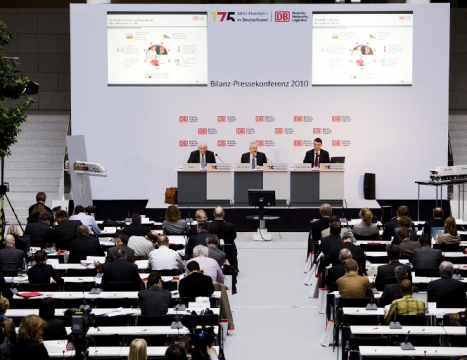
- Passenger transport generally
© DB Group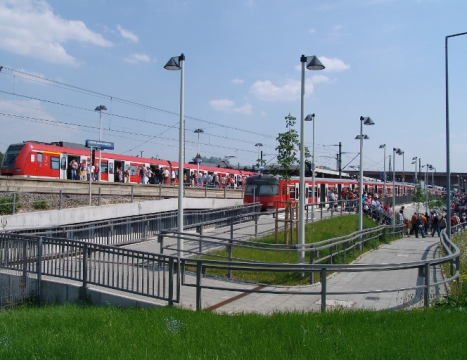
Despite facing uniquely difficult overall conditions stemming from the global economic and financial crisis, Deutsche Bahn was still able to remain clearly in the black in 2009 and closed out its financial year with an EBIT figure of 1.7 billion euros. During the presentation of the annual results in
Frankfurt Dr. Rüdiger Grube, CEO and Chairman of the DB Management, Board
stated: “Even during the worst crisis we were still able to defend our economic
strength and competitive position. The integrated Group impressively proved the
strength of its structure.” According to Grube the good results were only possible
because the company countered the crisis in a sustained way: “Our efforts to
decisively control our liquidity and make sustainable improvements to reducing
costs in 2009 enabled DB to make a 642 million euro contribution towards
improving our earnings.”
DB AG revenues in 2009 were significantly lower than in the previous year due to
the effects of the global economic decline. The decrease was especially notable in
DB’s rail freight transport and logistics areas of business. Revenues posted for the
entire Group fell by 12.3 percent to 29.3 billion Euro (previous year: € 33.5 billion).
Adjusted results from operations (adjusted EBIT) were 1.7 billion euro, or 0.8
billion below the comparable figure posted in the record-setting 2008 financial year.
Despite these setbacks, net debt was significantly decreased by 5.9 percent, or
932 million euros to currently 15 billion euros. DB CFO Diethelm Sack, who will
retire this year, noted, “The fact that we were able to further decrease our debt
despite the crisis reflects the strength of the company. This gives us the scope we
need to make necessary capital expenditures in the future.”
DB CEO Grube stated that the company would decisively continue its successful
course: “Defending the company’s economic strength and reducing our
indebtednessare two items that will remain at the very top of our agenda in the
future. There is no reasonable alternative to this stance, especially in the interest of
our customers. Only if we achieve these goals will we be able to remain
competitive and expand our position.”
Passenger transport almost unchanged
The number of passengers carried in the rail passenger transport segment in 2009
remained almost unchanged from the previous year’s figure, despite substantial
vehicle problems. DB’s rail business transported 1.93 billion passengers in 2009, or
14.2 million (- 0.7 percent) less than in 2008. Developments posted by the
individual business units varied. While DB Bahn Regional recorded a slight gain of
0.1, the DB Bahn Long-Distance (minus 0.4 percent) DB Bahn Urban (minus 2.5
percent) posted declines. The primary reason behind the weaker figures was the
reduced availability of ICE vehicles due to the shortened maintenance intervals
and the reduction in services offered by the Berliner S-Bahn (metro). Volume sold
also fell slightly by 1.3 percent to 76.8 billion passenger kilometers.
In contrast, the number of passengers transported by DB Bahn Urban’s buses
rose notably in the 2009 financial year by 3.8 percent, or 27.5 million, to 747.6
million. Volume sold in this segment increased by 0.9 percent to 8.4 billion
passenger kilometers.
Transport and Logistics: External revenues fall notably
Volumes shipped via DB’s rail freight transport business were considerably lower in
2009 than in the previous year due to the weaker economy. A slight recovery was
only noted during the fourth quarter of the previous year. The volume of goods
transported via DB Schenker Rail decreased by 10 percent, or 37.7 million tons to
341 million tons. Volumes sold amounted to 93.9 million ton kilometers or 19.7
billion ton kilometers (-17.3 percent) below the comparable year-ago figure.
External revenues fell by 18.5 percent.
Logistical services were also impacted by the effects of economic collapse. DB
Schenker Logistics posted a 3.8 percent decline in the volume of shipments
transported by its European land transport business in 2009. The decline noted for
air freight was notably steeper as the volume of freight transported fell by 16
percent in comparison to the previous year. Ocean freight volumes shipped in 2009
contracted by 2.1 percent. External revenues for DB Schenker dropped by 23.4
percent.
Reduced demand seen for rail infrastructure
Declining rail freight transport volumes also meant lower demand for train-path. DB
Netze Track recorded a corresponding decline in volumes sold of 41 million
train-path kilometers(Trkm), or 3.9 percent, to 1,001 million Trkm. Non-Group railways continued to expand their share of demand for train-path slightly (a gain of
2 percentage points to currently 17 percent). During the reporting period the
number of station stops rose marginally by 0.1 percent. The share held by
non-Group railways rose by 11.7 percent.
 All world news
 Interview
 Full text
 Events


