

|

|

Online Newsletter
Sign up for our newsletter to receive the latest news and information from publics.bg
Sign up for our newsletter to receive the latest news and information from publics.bg


News
World news


 05.12.2011 14:25
Greenpeace Activists Break into French Nuclear Plant
In a statement, Greenpeace said some members had entered the nuclear site at Nogent-sur-Seine, 95 kilometres (60 miles) southeast of Paris, to "spread the message that there is no such thing as safe nuclear power."
© greensefa@flickr.com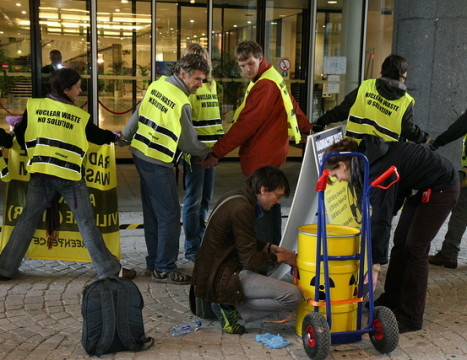
Activists from environmental group Greenpeace managed to sneak into a nuclear power plant near Paris on Monday in a move they said highlighted the dangers posed by France's reliance on atomic energy.
Police confirmed the intrusion and said activists had tried to break into two other nuclear sites in the south of France.
French energy giant EDF, which runs the nuclear plants that France relies on for 75 percent of its energy, sought to play down the incident, saying the activists at the plant near Paris had been detected but a decision made not to immediately intercept them.
EDF said activists had unfurled banners at two other sites but did not specify whether they had managed to enter the nuclear plants, as reported by AFP.
In a statement, Greenpeace said some members had entered the nuclear site at Nogent-sur-Seine, 95 kilometres (60 miles) southeast of Paris, to "spread the message that there is no such thing as safe nuclear power."
"A group of militants managed to climb on to the dome of one of the reactors, where they unfurled a banner saying 'Safe Nuclear Power Doesn't Exist'," said Greenpeace spokesman Axel Renaudin.
"The aim is to show the vulnerability of French nuclear installations, and how easy it is to get to the heart of a reactor," said Sophia Majnoni, a Greenpeace nuclear expert.
EDF insisted it had been aware of the intrusion from the start.
The activists "were immediately detected by the security system and were permanently followed on the site, without a decision being made to make use of force," the company said in a statement.
It said seven to nine people had been "calmly apprehended" by the French gendarmerie, a branch of the armed forces that protects nuclear sites.
Ladders and banners were also found near a nuclear power station in Blaye in southwestern France and at a nuclear research centre in Cadarache in the southeast, the gendarmerie told AFP.
EDF said banners had also been deployed at nuclear power plants in Chinon in central France and at Blayais in southwestern France, but "immediately removed." The company did not say whether activists had managed to enter those sites.
Henri Guaino, an advisor to President Nicolas Sarkozy, said the activists' move was "irresponsible" but raised questions about security at nuclear plants.
"It was irresponsible on their part," he told BFMTV. "But this does make one think about the security of access to nuclear power plants. Conclusions must be drawn from this."
The incident comes as some in France have begun to question the country's long-held support for nuclear energy.
 All world news
No published comments
Login to comment
 Interview
 Full text
 Events


