

|

|

Sign up for our newsletter to receive the latest news and information from publics.bg


News
World news


 13.04.2011 16:19
- The week 11-15 April is devoted to sustainable energy
© European Commission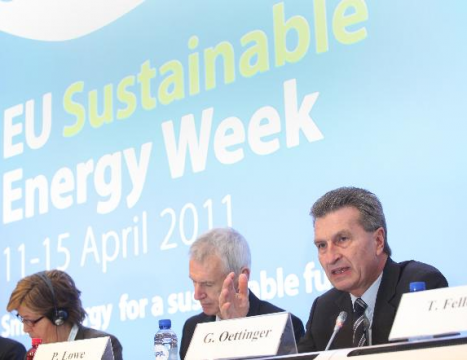
Energy taxes already exist in all EU Member States, and are harmonised to a certain degree at EU level. The current Energy Taxation Directive, adopted in 2003, was designed primarily to avoid competitive distortions in the energy sector within the Internal Market. It sets out common rules on what should be taxed, when and what exemptions are allowed. Minimum rates, based mainly on the volume of energy consumed, are laid down for products used in heating, electricity and motor fuels. Above these minimum rates, Member States are free to set their own national rates as they see fit.
The current Energy Taxation Directive is outdated in that it does not address the EU’s higher ambitions in energy and climate change policies. It also needs to be revised to address problems that have emerged in the Internal Market. Finally, its current scope is incoherent with that of the EU Emission Trading System (ETS) which is biggest international scheme for the trading of greenhouse gas emission allowances.
Firstly, the current minimum rates for energy products are mainly based on volume (EUR/1000l) and are set according to historical rates in the Member States. This creates unfair competition between fuel sources and unjustifiable tax benefits for certain types of fuel compared to others. For example, under the current minima, coal is the least taxed and ethanol is the most taxed. Renewables face particular discrimination under the current Energy Taxation Directive, because they are taxed at the same rate as the energy source they are intended to replace (e.g. biodiesel is taxed the same as diesel etc). As this rate is based on volume, rather than energy content, products with lower energy content such as renewables carry a heavier tax burden compared to the fuels they are competing with. This issue would be addressed in the Commission’s revised Directive, because energy tax would be linked to energy content.
Secondly, from a climate change point of view, the current Energy Taxation Directive does not address in any way the need to reduce CO2 emissions. In fact, as just outlined above, certain fossil fuels are taxed more favourably than cleaner competitors. An EU framework would allow Member States to apply a CO2 tax to meet their effort sharing targets, without fear of jeopardising their competitiveness within the EU.
Finally, a revised Energy Taxation Directive with a CO2 element would prevent a patchwork of national policies from creating obstacles and distortions in the Internal Market. Member States are already beginning to introduce their own national CO2 taxes, but different interpretations can lead to double taxation and high compliance costs for businesses operating cross-border. An EU approach to CO2 taxation would create a level playing field for industry across the EU, and make cross-border activity easier. CO2 taxation would not be applied to renewables, providing them with a further advantage compared to the conventional fuels they are competing with.
The revised Directive aims to restructure the way in which energy is taxed to support the objective of moving to a low-carbon and energy-efficient economy, and to avoid problems for the Internal Market.
- Climate Change: By introducing a CO2 element into energy taxation, the proposal aims to bring energy taxation in line with the EU’s climate change commitments. A price will be put on CO2 emitted by sectors outside the EU ETS: the higher the emissions of a particular fuel are, the higher the CO2 tax will be. This will reward greener energy sources and extend the efforts to meet the EU’s targets on CO2 reduction, energy efficiency and renewable energy.
- Energy Efficiency: Energy is scarce, and taxation should reflect this. Linking the level of tax to the energy content of fuels would create a great incentive across all sectors to be more energy efficient.
- Internal Market: Creating an EU framework for CO2 taxation would avoid a patchwork of environmentally friendly tax policies amongst Member States, giving businesses more legal certainty and reducing compliance costs. The proposal would also make a distinction between sectors covered by the EU ETS and those outside it, which would help to avoid double taxation.
- Promote growth and jobs: Member States could decide to operate a growth-friendly tax-shift, increasing taxation of energy products to reduce the tax burden on labour in line with the 2020 Strategy.
Taxes on energy would be split into 2 components: one based on CO2 content and the other based on energy content.
CO2: A single minimum rate for CO2 emissions (20 €/t CO2) would be introduced for all sectors not covered by the EU ETS. This would provide a carbon price for these sectors of the economy, namely households, transport, smaller businesses and agriculture that are outside the EU ETS. Renewable energy sources would not be subject to this CO2 element.
Energy: Minimum tax rates for energy would be based on the energy content of a fuel (€/GJ) rather than the volume. This means that a fuel will be taxed on the basis of the amount of energy that it generates, and greater energy efficiency will automatically be rewarded. The energy component of the tax will help to remove current distortions for competing energy sources (e.g. petrol and diesel) and will make taxation fairer for consumers because energy content is more important than volume when it comes to energy consumption. One GJ would be taxed in the same way, regardless of the product producing it.
Both CO2 and energy content elements would be combined to produce the overall rate at which a product is taxed. Member States will be free to set their own rates above the EU minima, and design their own structure for these taxes: for instance, they could decide to only increase the energy-content tax element above the minima and not the CO2 element or the other way round). However, the same rates and structure must then be applied to all fuels used for the same purpose (motor fuels or other fuels). Long transitional periods for the full alignment of taxation of the energy content, until 2023, will leave time for industry to adapt to the new taxation structure.
The energy element of the tax would apply to all fuel used for transport and heating. Non-fuel related uses of energy products will remain outside the scope of energy taxation as is currently the case (e.g. in metallurgical processes). The CO2 element of the tax will complement the emission trading system by applying to sectors that remain outside (transport, households, agriculture and small industries). In this way, all emissions from industrial installations will be subject to one CO2 price signal.
A number of reasons explain why it is now the opportune moment for the Commission to table this proposal. Firstly, as Member States design and implement their strategies to meet the EU 2013-20 energy and climate change goals, this proposal would provide a clear answer on the role that taxes could play. Secondly, the revised Energy Taxation Directive is designed to complement the third phase of the EU ETS (2013-2020) which will set forth an EU global CAP and provides for the move from allowances to auctioning. It is therefore urgent to make a proposal now to allow time for it to be agreed by Parliament and Council.
From an Internal Market perspective, it is also important to establish a common framework for CO2 taxation now. Member States are beginning to introduce their own CO2 taxes and their approaches may differ. A patchwork of national policies could create difficulties for businesses operating cross-border, and distortions in competition within the EU. It is therefore better to introduce an EU approach now, rather than later, when complex re-adjustments of national laws may be needed.
Lastly, the revision of the Energy Taxation Directive is also an element in the Europe 2020 Strategy and responds to a request made by the European Council of March 2008. It also echoes the UN Climate Change Conference that was held in Cancun, Mexico, in November and December 2010. In that way, it would contribute to sustainable growth, and the promotion of a more resource-efficient, greener and more competitive economy. Given that many Member States are now defining their policy strategies to exit from the economic and financial crisis the revised Energy Taxation Directive also provides opportunities to match environmental and economic targets. It would allow them, if they so choose, to shift some of the tax burden away from labour or capital and towards taxation that promotes environmentally-friendly, energy-efficient behaviour. Many different stakeholders, the European Parliament as well as a number of Member States, NGOs and parts of the business community are urging the Commission to come forward with this proposal as soon as possible.
The Commission has committed to promote energy efficiency to improve both EU competitiveness and security of supply while achieving more ambitious greenhouse gas reduction targets. Taxation is a powerful tool to steer consumers towards a more resource-efficient use of energy. Taxing energy products according to their energy content is the most efficient approach to incentivising a more efficient use of energy as it gives the user a clear price signal linked to the real "energy value" of the product he consumes.
As regards the energy component of the tax, the proposal will also strengthen the relevance of the minimum rates by ensuring that reductions below the minima will no longer be possible for businesses. Furthermore, the possibility to grant reduced tax rates, that would however need to be set above the minima will have to be clearly linked to the achievement of energy efficiency objectives, e.g. through industry agreements with verifiable savings objectives.
The revised Directive would begin to apply from 2013, to work in parallel with the third phase of the EU ETS. There would be an appropriate phase-in period for Member States to restructure their taxes, to allow national administrations, businesses and the energy sector time to adjust. Long transitional periods for the full alignment of taxation of the energy content, until 2023, will leave time for industry to adapt to the new taxation structure.
 All world news
 Interview
 Full text
 Events


