News

From Bulgaria Bookmark and Share

25.01.2011 15:29
Energy Experts: The New Law for RES Is Not Supportive Enough for Biomass
Kostadinka Todorova, director of the new Bulgarian Sustainable Energy Association, said that the new law is not fulfilling its main goal - to define a state policy for renewable energy
AUTHOR: Atanas Georgiev

  • Kiril Ermenkov (BEF), Valentin Nikolov (Parliament), Ivan Hinovski (BEF), Nikolay Nalbantov (MEET) and Valentin Ivanov (NEK) at the forum opening
    © publics.bg
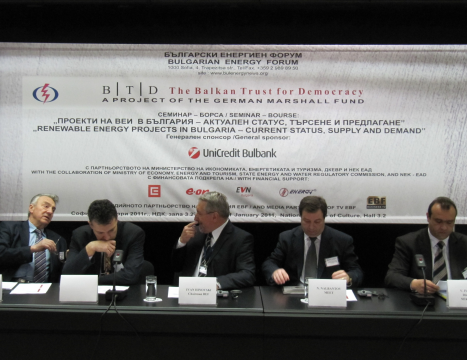
Some Bulgarian energy experts said today during the forum-bourse on renewable energy sources (RES), organized by Bulgarian Energy Forum (BEF), that the project for new Law on Renewable Energy is not good enough. Kostadinka Todorova, former director in the Bulgarian Ministry of Economy, Energy and Tourism (MEET) and current chairman of the new Bulgarian Sustainable Energy Association said that the law is not fulfilling its main goal - to define a state policy for renewable energy. Todorova said that the future law should have defined priority RES technologies. For instance, the law does not support enough biomass applications, Todorova added.

The member of Parliament Valentin Nikolov said that 2011 will be “Bulgaria’s Energy Year” because important projects have to be decided: natural gas pipelines, nuclear energy, and RES. Nikolov said that the Energy Strategy of Bulgaria is going to be voted soon in Parliament as well.

Ivan Hinovski, chairman of BEF, said that the purpose of today’s meeting is to hear different opinions in order to achieve balance of interests - for investors and grid companies. According to Hinovski, many investors with lack of knowledge on the energy sector have started investments in RES recently. They also lack knowledge on the stability of the energy system, he added.

Nikolay Nalbantov, director in MEET, also presented on the topic of the new Law for RES. He reminded, that new RES projects will have to pay a guarantee of about 2500 EUR per MW and later - a fixed initial price for connection of 25 000 per MW. This connection price will be then related to the real expense for connection and either investors will pay additional price, or some amount will be returned to them. Nalbantov also added that the target for 10% consumption from RES in transport sector could be achieved only with promotion of electric vehicles and biofuels will not be enough. Nalbantov said that RES projects may be financed by the Energy Efficiency Fund as well by changing its focus to RES as well with some corrections in the Energy Efficiency Law.

Evgeniya Haritonova, member of the State Energy and Water Regulatory Commission (DKEVR/SEWRC) did not provide enough details on the future fixed feed-in tariffs. However, she admitted that currently the licensing regime is too liberal and this will be changed with the new law.

Plamen Denchev
, former member of DKEVR, said that some of the Commissions proposals were not reflected in the new law. According to him, the law should be also related to the 10-year grid development plans of NEK (transmission grid owner) and distribution grid owners CEZ, EVN, and E.ON.


TAGS: MEET | DKEVR | SEWRC | NEK | CEZ | EVN | E.ON | grid | renewable energy | renewables | RES | BEF 


All news from Bulgaria

No published comments
Login to comment


Interview

20.03.2022  Teodor Bobochikov, Managing Partner, V-Ridium
Energy Transformation – Trends and drivers
Full text

Events

No records in this category!

Poll

What kind of transport do you use to get to work?


We use cookies to ensure we give you the best browsing experience on our website. Find out more on how we use cookies and how you can change your settings.

Cookies

What are cookies ?

A cookie is a small text file that a website saves on your computer or mobile device when you visit the site. Cookies are widely used in order to make websites work, or work more efficiently, as well as to provide information to the owners of the site.

How do we use cookies?

Website use Google Analytics, a web analytics service provided by Google, Inc. ("Google") to help analyse the use of this website. For this purpose, Google Analytics uses"cookies", which are text files placed on your computer.

The information generated by the cookies about your use of this website - standard internet log information (including your IP address) and visitor behaviour information in an anonymous form - will be transmitted to and stored by Google including on servers in the United States. Google will anonymize the information sent by removing the last octet of your IP address prior to its storage.

According to Google Analytics terms of service, Google will use this information for the purpose of evaluating your use of the website and compiling reports on website activity.

We not use, and not allow any third party to use the statistical analytics tool to track or to collect any personally identifiable information of visitors to this site. Google may transfer the information collected by Google Analytics to third parties where required to do so by law, or where such third parties process the information on Google`s behalf.

According to Google Analytics terms of service, Google will not associate your IP address with any other data held by Google.

You may refuse the use of Google Analytics cookies by downloading and installing Google Analytics Opt-out Browser Add-on. The add-on communicates with the Google Analytics JavaScript (ga.js) to indicate that information about the website visit should not be sent to Google Analytics.

Cookies are also used to record if you have agreed (or not) to our use of cookies on this site, so that you are not asked the question every time you visit the site.

Google Analytics Opt-out Browser Add-on

How to control cookies?

You can control and/or delete cookies as you wish. You can delete all cookies that are already on your computer and you can set most browsers to prevent them from being placed.

All about cookies

Managing cookies in your browser

Most browsers allow you to:
  • see what cookies you have got and delete them on an individual basis
  • block third party cookies
  • block cookies from particular sites
  • block all cookies from being set
  • delete all cookies when you close your browser

If you chose to delete cookies, you should be aware that any preferences will be lost. Also, if you block cookies completely many websites (including ours) will not work properly and webcasts will not work at all. For these reasons, we do not recommend turning cookies off when using our webcasting services.
X
} catch(err) {}