News

World news Bookmark and Share

22.11.2010 17:31
BASF and Gazprom celebrate twenty years of partnership
One of the routes the Russian gas will take will be through the Nord Stream pipeline in the Baltic Sea, which has been under construction since April 2010
AUTHOR: publics.bg

  • Alexey Miller, Chairman of the Management Committee of OAO Gazprom, and Dr. Jürgen Hambrecht, Chairman of the Board of Executive Directors of BASF SE
    © BASF
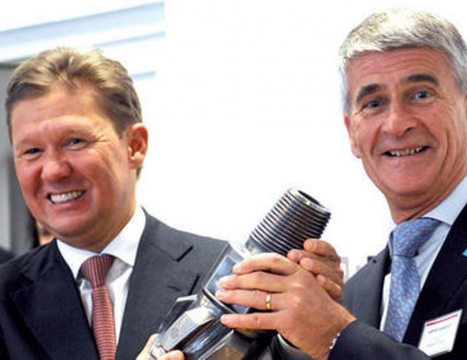

BASF and its oil and gas subsidiary Wintershall commemorated 20 years of German-Russian economic history together with Gazprom at an anniversary event in Berlin. The companies laid the foundations for their cooperation in fall 1990 with a long-term agreement to market Russian natural gas in Germany. Together with more than 200 guests, Dr. Jürgen Hambrecht, Chairman of the Board of Executive Directors of BASF SE, and Alexey Miller, Chairman of the Management Committee of OAO Gazprom, celebrated the anniversary of the successful and pioneering economic cooperation.

Today, the partnership between the world’s leading chemical company and the world’s largest producer of natural gas extends from the exploration and production of natural gas in West Siberia to transportation through the Nord Stream pipeline and the sale of the natural gas in Germany and Europe by the jointly owned natural gas trading company WINGAS. The German-Russian cooperation was unprecedented in the gas industry in 1990. What began with a shared declaration of intent on cooperation in the gas sector shortly before the reunification of the two German states has now grown into a solid and equal partnership, the official message from BASF says.

“From today’s perspective, the cooperation represents a historic step towards securing Europe’s energy supply,” said BASF Chairman Hambrecht. “When Gazprom and BASF signed the first agreements at the beginning of the 1990s, hardly anyone could have imagined how successful this partnership would become. Today we are very proud of what we have accomplished and can look to the future with optimism. After all, there is still a great deal we intend to achieve together,” Hambrecht continued.

“The two decades of partnership between Gazprom and Wintershall exemplify the success of cooperating in business. Over the years we have solved more than one difficult task: we have begun developing the difficult-to-access Achimov deposit of the Urengoy reservoir and we are building the Nord Stream gas pipeline, which is important for the European market,” said Gazprom Chairman Alexey Miller. “We now work along the entire value creation chain – from production through to sales. Our relationship is based on mutual trust and appreciation. Our employees and business partners are increasingly becoming good friends. I firmly believe that new success stories lie ahead of us, and just as many outstanding and interesting projects,” Miller explained.

One of the routes the Russian gas will take will be through the Nord Stream pipeline in the Baltic Sea, which has been under construction since April 2010. This pipeline connects the Siberian gas reserves directly with Germany. Over 600 kilometers of the 1,220-km-long pipeline have already been laid, including the sections off the coast of the island of Gotland, and the sections where the pipeline comes on land in Germany and Russia. The first leg of the pipeline is scheduled to come on stream in October 2011.


TAGS: Gazprom | Wintershall | BASF | Nord Stream | natural gas | pipeline 


All world news

No published comments
Login to comment


Interview

20.03.2022  Teodor Bobochikov, Managing Partner, V-Ridium
Energy Transformation – Trends and drivers
Full text

Events

No records in this category!

Poll

What kind of transport do you use to get to work?


We use cookies to ensure we give you the best browsing experience on our website. Find out more on how we use cookies and how you can change your settings.

Cookies

What are cookies ?

A cookie is a small text file that a website saves on your computer or mobile device when you visit the site. Cookies are widely used in order to make websites work, or work more efficiently, as well as to provide information to the owners of the site.

How do we use cookies?

Website use Google Analytics, a web analytics service provided by Google, Inc. ("Google") to help analyse the use of this website. For this purpose, Google Analytics uses"cookies", which are text files placed on your computer.

The information generated by the cookies about your use of this website - standard internet log information (including your IP address) and visitor behaviour information in an anonymous form - will be transmitted to and stored by Google including on servers in the United States. Google will anonymize the information sent by removing the last octet of your IP address prior to its storage.

According to Google Analytics terms of service, Google will use this information for the purpose of evaluating your use of the website and compiling reports on website activity.

We not use, and not allow any third party to use the statistical analytics tool to track or to collect any personally identifiable information of visitors to this site. Google may transfer the information collected by Google Analytics to third parties where required to do so by law, or where such third parties process the information on Google`s behalf.

According to Google Analytics terms of service, Google will not associate your IP address with any other data held by Google.

You may refuse the use of Google Analytics cookies by downloading and installing Google Analytics Opt-out Browser Add-on. The add-on communicates with the Google Analytics JavaScript (ga.js) to indicate that information about the website visit should not be sent to Google Analytics.

Cookies are also used to record if you have agreed (or not) to our use of cookies on this site, so that you are not asked the question every time you visit the site.

Google Analytics Opt-out Browser Add-on

How to control cookies?

You can control and/or delete cookies as you wish. You can delete all cookies that are already on your computer and you can set most browsers to prevent them from being placed.

All about cookies

Managing cookies in your browser

Most browsers allow you to:
  • see what cookies you have got and delete them on an individual basis
  • block third party cookies
  • block cookies from particular sites
  • block all cookies from being set
  • delete all cookies when you close your browser

If you chose to delete cookies, you should be aware that any preferences will be lost. Also, if you block cookies completely many websites (including ours) will not work properly and webcasts will not work at all. For these reasons, we do not recommend turning cookies off when using our webcasting services.
X
} catch(err) {}