

|

|

Sign up for our newsletter to receive the latest news and information from publics.bg


News
World news


 09.09.2010 22:47
© Alstom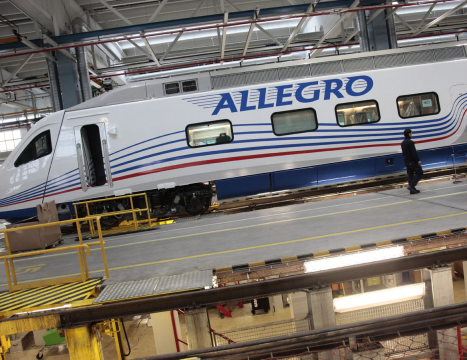
Russian Railways Vice President and Federal Passenger Company General Director Mikhail Akulov made this announcement on September 8 at a briefing for journalists.
The launch of the high-speed service will reduce the journey time between St. Petersburg and Helsinki (a distance of 443 km) from the current 6 hours 18 minutes to just over 3 hours 30 minutes, while the journey time on Russian territory will be reduced from 3 hours 11 minutes to 90 minutes. The shorter journey time is due to the more technically advanced trains, quicker border checkpoint formalities, and greater travelling speeds. The Allegro trains will be able to reach 200 km/h on Russian territory, and 220 km/h on Finnish territory.
"In the first stage, two return journeys will be made daily. The Allegro service from Helsinki to St. Petersburg will depart at around 10:00 and 15:00, and the service from St. Petersburg to Helsinki at around 6:40 and 15:25", Mikhail Akulov said.
The Allegro trains will stop at Vyborg, Vainikkala, Kouvola, Lahti, Tikkurila, and Pasila.
Mr Akulov said that from the moment the Allegro train service is launched, Finland’s Sibelius train and Russia’s Repin train will cease to run between St. Petersburg and Helsinki. The Russian night train Lev Tolstoy will continue to operate between Moscow and Helsinki.
"By summer 2011, the number of daily return journeys is planned to be increased from two to four", the Russian Railways vice president said.
The Allegro trains produced by the French company Alstom have 344 seats, of which 296 are second-class and 48 are first-class. The trains have seats for physically impaired passengers and passengers with pets, and a conference room. Each train will have a children’s play area.
The Allegro trains are designed to be dual-system, i.e. they are intended for use on tracks with both direct and alternating current. While in motion, the trains can tilt by up to 8 degrees, allowing them to round curves without losing speed. Currently, two trains are undergoing certification testing in Russia, and one in train in Finland.
As part of the project to launch the high-speed service, Russian Railways reconstructed the 157-km St. Petersburg – Buslovskaya section of the line. Work to prepare the infrastructure for high-speed services is ongoing, and work is also being carried out under this project to transfer freight traffic to the Ruchyi – Petäjärvi – Kamennogorsk – Vyborg line. The total project cost is 79.7 billion rubles (around 2 billion euros).
 All world news
 Interview
 Full text
 Events


