

|

|

Sign up for our newsletter to receive the latest news and information from publics.bg


News
World news


 09.09.2010 14:22
- Audi A1 e-tron
© audi.de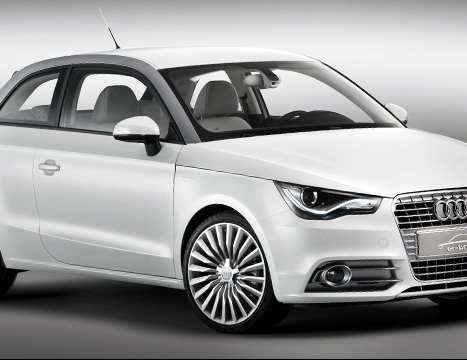
The project partners Audi, E.ON, Stadtwerke München (SWM) and Technische Universität Munich (TUM) fired the starting shot for a fleet test with electric cars in the Munich model region today. By the middle of next year 20 Audi e-trons will come onto the roads successively and 200 new charging stations will be set up. The project is running as part of the “Munich Model Region Electro-mobility” under the name “eflott” (efast) supported by the German federal Ministry of Transport. Among others it will look at data transmission between the driver, car and electricity fuel station all the way up to the electricity grid. For this purpose the use of smartphones as a central interface for the driver will be tested, for example.
The A1 e-tron is an innovative Mega City Vehicle (MCV) wit h electric drive. Its range in city traffic is over 50 kilometres. The maximum output of the vehicle is 75 kW (102 bhp). If the battery runs out of energy a compact combustion engine recharges the battery. The top speed is over 130 km/h. For the first 50 kilometers it drives, such as in city traffic, the compact MCV produces no emissions. A package of lithium ion modules acts as the battery, set in front of the rear axle in the undercarriage.
In exceptions a compact single disc Wankel engine increases the range of this model, which is very close to the series range. This so-called Extender operates a generator, which produces a charging output of 15 kW. When it recharges the battery the A1 e-tron can reach an additional range of 200 kilometres. According to the draft for standardisation to determine the consumption of Range Extender vehicles their fuel consumption is 1.9 l/100 km – equivalent to CO2 emissions of just 45 g/km.
E.ON and SWM are installing the necessary charging infrastructure, E.ON primarily in the surrounding area, SWM in the Bavarian capital. In total the two energy providers are each setting up 100 “electricity fuel stations”. All charging stations are fed with electricity acquired from renewable energies.
The TU Munich will comprehensively record and evaluate mobility behaviour during the course of the project: how much and in which situations is an electric car used? And what influence do they have on the use of other methods of transport? To clarify these questions the Chair for Vehicle Technology has developed a mobile application that all participants in the fleet test will get on a smartphone. The device will record all their mobility behaviour - from the bicycle, e-car and conventional car up to the bus and train. To ensure that the participants also use the smartphone permanently the Chair of Ergonomics has created a design that is convenient and will sustain motivation for the application. Simultaneously the Chair of Marketing is preparing a study that will reveal which billing model for the electricity used by e-mobility achieves greatest customer acceptance.
The fleet test is also being supported by the German Federal Ministry of Transport as part of a research project. “Electro-mobility is not an abstract technological question. At its heart it concerns what the transport system of the future will look like. Therefore we are supporting electro-mobility in our model regions under everyday conditions – a large practical test so to speak. We are collecting important findings from projects like this one about how electro-mobility can work successfully. In both the town and in the country. In the Munich model region we are supporting electro-mobility with around € 10 million. This money is a good investment in the future. We have a fixed target: we want to make Germany the leading market for electro-mobility and bring at least one million electric vehicles onto German roads by 2020,” said German Transport Minister Peter Ramsauer.
“Audi is working flat out on the future of mobility. We’re looking for a concept without compromises,” underlined Rupert Stadler, Chairman of the Board of AUDI AG. And he continued: “Electro-mobility does not mean electrifying vehicles retrospectively. Instead we want to deal with this issue holistically in all its aspects. With this fleet test on a broad basis we want to learn more about the behaviour and also the expectations of our customers when dealing with electric cars. Other aspects are of course, the data that we will collect in doing so. We will further develop our expertise in electrification with this feedback from the market and technology.”
Klaus-Dieter Maubach Technology Board Member of E.ON AG emphasised: “In this project we are extending our electricity fuel stations to existing parking areas in accordance with our findings about user behaviour. For example, we are equipping private garages and car parks with charging facilities. In this way we want to further develop charging point technology and especially communication with grid operators, thus consolidating our leading role in developing electricity fuel stations. After all, intelligent charging points are more than just electricity fuel stations: they are the pre-condition for using vehicle batteries as interim storage for renewable energies in the intelligent electricity grids of the future.”
As U-Bahn train and tram operators the SWM has decades of experience in electro-mobility in public transport. In developing the charging infrastructure they are not only making a commitment to the area of sustainable individual transport. Dr. Florian Bieberbach, Commercial Director of the SWM: “Only our eco-electricity will flow at the SWM charging stations. In this way the vehicles’ CO2 emissions are precisely zero. The basis for this is our commitment to developing renewable energy. By 2025 we want to generate so much green electricity in our own facilities that we can cover all of Munich’s electricity needs - including for e-vehicles. Thus Munich would be the first city with over a million inhabitants to reach this ambitious target."
“From a research point of view the question is not if but only when electro-mobility establishes itself. Electro-mobility means a paradigm change for industry and society. It is thus a central strategic focal point of the TUM,” said Professor Wolfgang A. Herrmann, President of the TU Munich. “The Electro-Mobility Science Centre at the TUM combines the expertise of 42 chairs from eight faculties which are contributing to the development of sustainable individual mobility with great commitment.”
Key facts for the project:
Project partners Audi, E.ON, Stadtwerke München and TU Munich
20 Audi e-trons will comes onto the roads successively
200 “electricity fuel stations” will be set up
Eco-electricity will flow at all charging stations
Data transmission between driver, car, charging station and electricity grid
 All world news
 Interview
 Full text
 Events


