

|

|

Sign up for our newsletter to receive the latest news and information from publics.bg


News
World news


 22.04.2015 15:54
© Press Office of the European Commission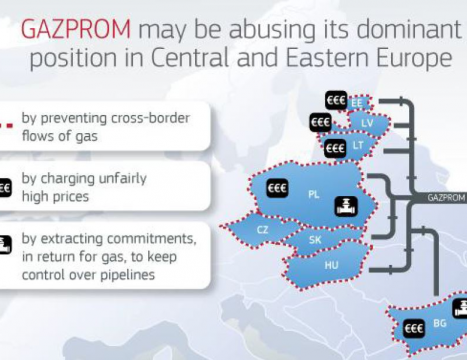
The European Commission has sent a Statement of Objections to Gazprom alleging that some of its business practices in Central and Eastern European gas supply segment the EU's Single Market and constitute an abuse ofits dominant market position in breach of EU antitrust rules.
Gazprom is the dominant gas supplier in a number of Central and Eastern European countries. It has a market share well above 50% and in some cases up to 100% in these markets. In light of its antitrust investigation, the Commission's preliminary view is that Gazprom is hindering competition in the gas supply markets in eight Central and Eastern European Member States (Bulgaria, the Czech Republic, Estonia, Hungary, Latvia, Lithuania, Poland and Slovakia).
On the basis of its investigation, the Commission's preliminary view is that Gazprom is breaking EU antitrust rules by pursuing an overall strategy to partition Central and Eastern European gas markets with the aim of maintaining an unfair pricing policy in several of those Member States. Gazprom implements this strategy by:(i) hindering cross-border gas sales,(ii) charging unfair prices, and (iii) making gas supplies conditional on obtaining unrelated commitments from wholesalers concerning gas transport infrastructure.
1. Gazprom might be hindering cross-border gas sales, the Commission announced in a statement today.
Gazprom has included a number of territorial restrictions in its supply agreements with wholesalers preventing the export of gas in eight EU Member States (Bulgaria, the Czech Republic, Estonia, Hungary, Latvia, Lithuania, Poland and Slovakia). These clauses include:
- export ban clauses - provisions that explicitly prohibit the export of gas; destination clauses - provisions that stipulate that the customer (wholesaler or industrial customer) must use the purchased gas in its own country or can only sell it to certain customers within its country; and
-other measures that prevent the cross-border flow of gas, such as requesting wholesalers to obtain Gazprom's approval for exports or refusing to change the location to which the gas should be delivered under certain circumstances.
-The Commission's preliminary view is that Gazprom is using these territorial restrictions to prevent gas from flowing freely between and to the eight Central and Eastern European countries. As a result these Member States do not have access to imported gas at potentially more competitive prices.
Territorial restrictions have a negative impact on gas prices preventing cross-border flows of gas and leading to market partitioning. In particular, they hinder gas from flowing where it is most needed and where prices are commercially most attractive.
Wholesale gas prices across the Central and Eastern European Member States can differ significantly. If gas prices in one country are higher than in another, then the wholesaler in the low price Member State should be able to sell surplus gas that it does not need to meet its domestic consumption to a market where prices are higher. Territorial restrictions prevent such price arbitrage. As a result of these restrictions, wholesalers cannot compete with Gazprom, in other words, Russian gas cannot compete with Russian gas. This leads to higher prices and gas markets that are segmented alongnational borders.
The Commission has already made clear in past decisions that territorial restrictions and measures to partition the market are anticompetitive:
In 2004, the Commission adopted two decisions,regarding contracts concluded by GDF (Gaz de France) with Italian companies ENI and ENEL, confirming that territorial restriction clauses in the gas sectorrestrict competition.The territorial restriction clauses prohibited ENI and ENEL from selling in France the natural gas which GDF transported on their behalf. The clauses therefore prevented French consumers from obtaining their supplies from the two Italian operators and
- hindered competition in the market.
In 2009, the Commission fined EDF and E.ON under Article 101 of the Treaty on the Functioning of the European Union (TFEU) not to sell gas transported over the MEGAL pipeline in each other's home markets.
-The Commission also has an ongoing antitrust case concerning territorial restrictions in the electricity sector in Bulgaria against Bulgarian Energy Holding (BEH), which may have limited purchasers' freedom to choose where to resell the electricity bought from BEH. The Commission sent a Statement of Objections to BEH in March 2015.
2. Gazprom's alleged unfair pricing policy
The Commission's investigation concerns the prices that Gazprom’s customers such as gas wholesalers and industrial customers pay for their gas. These wholesale prices play an important role in determining the prices for gas charged at retail level to households and businesses. They can also impact the prices of industrial goods for which energy costs are an important factor in the production costs.
Generally, Gazprom pegs the price of the natural gas it sells to a number of oil products (so-called "oil indexation"). The Commission is investigating whether, and to what extent, the individual price levels in a country are unfair and how Gazprom's specific price formulae based on oil indexation have contributed to the unfairness. The Commission does not consider that indexing a product's price to oil products or any other product is in itself illegal. It also does not take issue with the fact that gas prices are different in different countries. Competitive conditions may vary in Member States, such as the importance of gas as an energy source in a country's "energy mix". In order to assess whether individual price levels in a country are unfair, the different Member State prices were compared to a number of different benchmarks, such as Gazprom's costs, prices in different geographic markets or market prices. On the basis of this analysis, the Commission has come to the preliminary conclusion in its Statement of Objections that the specific price formulae, as applied in Gazprom's contracts with its customers, have contributed to the unfairness of Gazprom's prices:
Gazprom's specific price formulae which link the price of gas to the price of oil products seem to have largely favoured Gazprom over its customers. The Commission's preliminary conclusion, as outlined in the Statement of Objections, is that Gazprom has charged unfair prices in five Central and Eastern European countries (Bulgaria, Estonia, Latvia, Lithuania and Poland).
3. Concerns on gas transport infrastructure
The Commission has concerns that Gazprom leveraged its market dominance in Bulgaria and Poland by making gas supplies conditional upon obtaining certain infrastructure-related commitments from wholesalers.
In Bulgaria, the Commission's preliminary view is that Gazprom made wholesale gas supplies conditional upon the participation of the Bulgarian gas incumbent wholesaler in a large-scale infrastructure project of Gazprom (the South Stream pipeline project) despite high costs and an uncertain economic outlook.
In Poland, the Commission's preliminary view is that Gazprom made gas supplies conditional upon maintaining Gazprom’s control over investment decisions concerning one of Poland’s key transit pipelines (Yamal). This pipeline is one of the main infrastructures that could allow gas from suppliers – other than Gazprom – to enter the Polish market.
 All world news
 Interview
 Full text
 Events


