

|

|

Sign up for our newsletter to receive the latest news and information from publics.bg


Interviews


 16.10.2013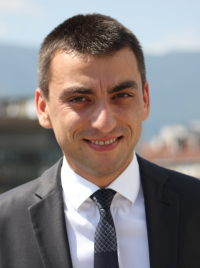
The interview with Mr. Georgiev is also published in the latest issue of the Bulgarian UTILITIES magazine.
Mr. Georgiev, how does ATEB assess the development of the electricity market in Bulgaria over the last months?
The electricity market in the country is still in development, which is a stage far from the optimal model of a well developed and liquid market. However, it has to be borne in mind that many steps were taken over the last months towards a better development and towards a more successful functioning. These changes concern both the customer supply market in the country and the energy export sector, which is very important for our energy system. In this respect, I would like to draw the attention and mention the following points as a very positive development.
First, the adoption of the new rules for trading with electricity, creating the prerequisites for the full opening of the market for the end-customers, the introduction of balancing groups and of a balancing market based on market principles, the introduction of hourly schedules for the participants in all segments of the market, and the finalization of the rules that govern the electricity exchange are a very positive development.
Also, the amendments to the Energy Act (EA) and to the Energy and Renewable Sources of Energy Act (ZEVI), which bring on a reduction of costs in the energy system and a respective turn down of the prices of electricity, more specifically in terms of network charges and of their added supplements for purchase cancellation.
And last, but not least, there is a significant improvement of the sales procedures, organised by the main producers i.e. the introduction of standard products, the discontinued distinction between energy for domestic market and for export, the increased dynamics and flexibility of the market policies of the companies - for example the short-term sales.
What are the results you see after the changes electricity pricing model and the reduction of the export fee as of 1st August?
As I mentioned earlier, ATEB sees the changes in the forming of prices and the decrease of the network components, including the reduction of the export fee as a very important, although long delayed step in the right direction, which gives immediate results.
The levying of fees on the exported electricity is an anti-market practice, which is applied only in a few countries in Europe and their number is decreasing. Recently the export fees in Macedonia and in Bosnia and Herzegovina have been completely cancelled while in Romania they were reduced to levels lower than those in Bulgaria, with a planned full removal in 2014. In another country which currently applies export fees – Greece, it is also planned for them to be cancelled starting from 1 January 2014.
There is a wrong understanding in society and among certain participants in the energy sector that the export fees are beneficial for the country; that they protect the interests of the end users; that they prevent the export of the cheap electricity, etc. To the contrary, an expert and market analysis shows that the export fees have a strong negative impact on the energy sector in the country, which was very tangible in the first half of 2013. The high electricity production availability in Bulgaria combined with low domestic consumption and minimal export, blocked by the high export taxes put our energy sector into a system and financial collapse. The decrease of the export during the first quarter of the year is more than 50% compared with the same period of the previous year, which according to ATEB’s calculations leads to lost profits for the Bulgarian energy sector amounting to more than 110 million BGN.
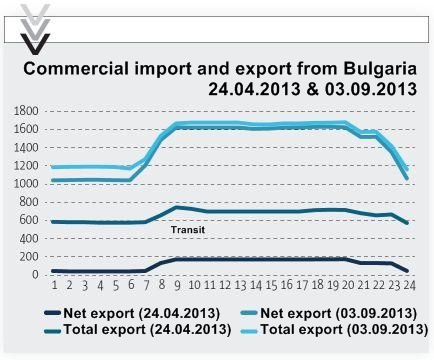
During the second quarter this process deepened further as the decrease in April and May is more than 85% as compared to the same period of 2012. All this turned Bulgaria from a net exporter into a transit country with volumes of up to 500 MWh of electricity per hour. This energy produced in other countries reached the traditional for our country neighbouring markets, without any income for our energy sector being generated in this process. We even had the situation when one unit in the Kozloduy nuclear power plant with diminished production, which costs a lot, instead of having the produced energy that could be sold on the neighbouring markets, thus generating revenues. Similar was also the situation in the TPP Maritsa East II, which over long periods of time produced around 300-350 MWh per hour, having generation capacities of 1600 MW.
Over the last years ATEB has repeatedly raised before the responsible authorities the issue about the negative impact of the high fees levied on the energy exported from the country and noted that their continued increase (more that 250% for the last 5 years) will lead to negative results, but until now our opinion was not taken into account. I would like to congratulate in this context the legislator for the amendments of the Energy Act (EA) and of the Energy and Renewable Sources of Energy Act (ZEVI), as well as the State Energy and Water Regulatory Commission (DKEVR) for its determination to reduce the electricity fees starting from 1 August of this year, despite of the numerous objections from the market participants against the adoption of such decisive actions.
The decrease of the supplements for purchase on the exports had an immediate effect – as early as still in August the export reached hourly levels of 1600-1700 MWh, or 944 000 MWh monthly amount. That is a tenfold increase as compared to the volumes in May, generating revenues for the Bulgarian energy sector of more than 80 million BGN (about 40 million EUR) only within the scope of a month. It is important to note that these revenues are generated mainly using local energy resources such as coal and water i.e. they remain fully within the different components of the energy sector in the country. In addition, the transit via the country declined to the insignificant rate of 2-3% as compared to the 70% observed in May; the energy system of the country is much better balanced; the main power plants operate at higher capacity, which increases their efficiency; coal mining has significantly risen; and last but not least – Bulgaria recovers its position of a leading exporter of South-Eastern Europe.
Are there opportunities not just to export but also to import electricity from some neighbouring markets?
There are no legal or procedural obstacles to import electricity for consumption in the country. However, such imports are practically not carried out. The main reason for this is the lack of integration of the Bulgarian market with the regional one, due to the applied network fees in Bulgaria, which are levied on both imported and exported electricity. In the instance of any possible cancellation of the taxes and of the integration of our market with the regional market, the consumers in our country will be able to take advantage of the opportunities that are available on the neighbouring markets.
What are your expectations as to the liberalisation of the Bulgarian electricity market with the real start of the balancing groups? Do you expect new customers of the energy traders?
The introduction of balancing groups is a long expected step, giving a strong impetus to the market development. One of the main concerns of the local consumers is the cost for imbalances, which in the conditions of balancing groups decreases significantly. The balancing groups are one of the reasons for the significant increase of the number of consumers, who benefit from the advantages of the market. According to the Register of the market participants, published by the Energy System Operator, only for the period from 01.07.-01.08.2013 the newly registered users are more than 270, including users, connected to low voltage networks. Our expectation is that this trend will be maintained, and that we shall witness the increase of both the customers of energy traders and of new coordinators of balancing groups, offering innovative products and services to their customers.
In what main areas does the Association of traders of electricity in Bulgaria (ATEB) work? How do you work in partnership with public institutions and with the other stakeholders on the market?
Some of the main objectives of the ATEB are to promote and support the development of the market relations in the energy sector in the country, to improve the market infrastructure and the principles and mechanisms of the regulatory framework, governing the relationship on the market. With a view to achieve these objectives, we try to maintain an active communication at the managerial and expert level with the responsible institutions such as the Ministry for economy and energy (MIE), DKEVR, as well as with the main generators of electricity and with the Bulgarian Federation of the Industrial Energy Consumers (BFIEC). In carrying out this activity we actively cooperate with the European Federation of Energy Traders (EFET), which is an important partner of ours, which shares its expertise and experience from the more developed European markets.
How do you evaluate the development of the professional knowledge and competences, linked to our energy market? Are there a sufficient number of enough trained specialists in the sector and how the training process can be improved?
The trade with electricity is a specific activity, which requires complex knowledge and skills. A good trader must have engineering, economic, financial and judicial knowledge. He or she must have analytical skills and commercial senses. Most of the employees in the companies of our members are graduate economists and engineers, who in the process of the work gain more qualification and learn other necessary knowledge.
Currently I am aware of only one training programme that offers specific education in line with the needs of the energy traders – I have in mind the Master’s programme in Economics and Management of Energy, Infrastructure and Utilities at the Faculty of Economics and Business Administration of Sofia University "St. Kliment Ohridski". My impressions of the graduates of this programme are very good and many of them have successful career realization in the energy companies. I believe that with the development of the market and with the increased awareness of the young about the trade with electricity, the interest in acquiring the necessary specific education will grow and respectively – the opportunities to acquire the necessary knowledge will grow too.
____________
Martin Georgiev is manager of Alpiq Energy Bulgaria EOOD and Chairman of the management board of the Association of Traders with Electricity in Bulgaria (ATEB). Before joining Alpiq, Martin worked as Key Accounts Manager at Aare-Tessin Ltd. for Electricity (Atel) in the holding’s HQ in Switzerland. Before this he was Program manager at Uconomics. He has experience as a consultant for the liberalization of the electricity market in Bulgaria, as well as a specialization in economics and management of the energy sector. He graduated from the Masters program “Automation, information and control technologies” at the Technical University of Sofia and an executive MBA from the American University in Bulgaria. He is also a certified spot-trader at the European Electricity Exchange (EEX).
 All interviews
 Interview
 Full text
 Events


