

|

|

Sign up for our newsletter to receive the latest news and information from publics.bg


Interviews


 01.09.2010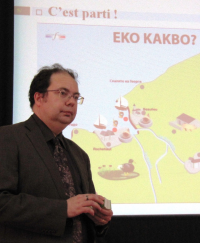
Mr. Courtecuisse, this autumn your twinning project in the Bulgarian Ministry of Environment and Water (MOEW) will be completed. Please tell us what are the main goals of the project.
- The main goal of the project was to help the Bulgarian Ministry of Environment and Water and the four basin directorates to follow the implementation of the Water Framework Directive and mainly to develop the programs of measures and the River Basin Management Plans that were supposed to be finalized by the end of 2009 and reported to the European Commission before the end of March 2010. In fact, Bulgaria was one of the few countries, which managed to do this within the deadlines.
The second goal was to introduce a little more economic analysis in the water management of Bulgaria – to take the opportunity to review what has been done in terms of economic analyses. The Water Framework Directive was very demanding in this part. And also, to see what could be done in coming years in order to develop further use of economic analyses.
Finally, but still in connection to the second goal, we had to look on the specific issue of water pricing and environmental fees. There has been a project since 7 years to evaluate the current system of fees and one of the purposes of our project was to define how to change the existing fees. Currently there are many taxes for the abstraction of water and we had to evaluate what improvement could be done in order to collect more funds. Sometimes not all the people who should pay really do it. We had also to develop this system to include as well pollution – from municipalities, industry, agriculture. This system of fees had to be evaluated in order to use it as a possibility to finance the programs of measures.
Bulgarian water sector will need substantial investments in the next several years. What funds should be used in order to complete all the projects needed?
- Huge investments will be needed in the next years. The municipalities will have to implement wastewater treatment plants (WWTP) and sewerage networks. They could get some funds from Europe but in the end there will be more assets and more operating costs. It is important for the water sector to see that this process will lead to a complete change in costs. They have to think as well about the renewal of these assets in future – after 20 or more years, when there will be no funding from the EU. The water sector has to start this evolution in order to face the challenge.
In our discussion with municipalities and the ministry we found out that besides the investment in wastewater and sewerage assets, there is still a great need for investments in the water supply. In many places across Bulgaria there are large percentages of leakages and this problem has to be managed.
And finally – climate change has to be evaluated as well. There are already some places in Bulgaria where water scarcity is present. You have to either find new sources or replace the leaking pipes in order to have more water available. But these water supply investments could not be financed by the current EU funds, so this is a problem for municipalities. They have to observe the deadlines of the Water Framework Directive, because otherwise penalties could be imposed. On the other hand, there are the issues with water supply, which require from municipalities to improve this part of the water cycle.
Some of the municipalities are not capable enough to prepare and implement such projects. What technical support should they use?
- This is a big issue for municipalities. Regarding all the investment needs, they have to get financing from the ministries, from PUDOOS, etc. The new organization of the water sector with the water associations means that there will be a need for new skills in the municipalities regarding the technical aspect in order to choose the best options. We are just back from a mission in the West-Aegean Basin Directorate where we met with municipalities. Regarding the treatment options, there are several ones related to the landscape, the height of the municipality, as well as different options for the sludge. The process for the sewerage and WWTP investments is not so easy – there is not a single technical solution. You have to look for the most appropriate one based on the local specifics.
There is also a need for financial expertise in the municipalities. They will play a bigger role in the management of water services even if there is a separate water and sewerage utility company. If the municipalities own the assets, they have to receive part of the water tariffs in order to be ready to replace and maintain pipes.
Inside the project we developed a simple Excel price model, which could evaluate the investment and how different options impact the final price, regarding different assumptions on financing options, consumption levels, etc. The purpose of this model was not to make some kind of a pricing crystal ball but to let the basin directorates and the municipalities evaluate the impact of financial sources for instance. Another sensitive parameter is the consumption level. In many countries where big investments were made, the increase in prices usually leaded to reduced consumption because of the price elasticity of demand. When the basic user receives a higher bill, there will be an incentive to reduce consumption, for instance through some technical solutions.
In general, new capacity and new competences should be developed in municipalities in order to deal with these issues.
Water and wastewater services in Bulgaria are currently predominantly run by state-owned and municipally-owned companies. Is there a possibility to make more public-private partnership?
- Now with the change of the law, the door for public-private partnership is open in the field of water supply and wastewater treatment. One of the key messages from the water seminar that the French embassy organized in April 2010 is that if you choose to make a PPP, you need also a tool for evaluating what has been done by the water services operator. If you look at the experience in France, the system is now better, because there is more capacity in the municipality and they developed a dashboard of indicators for the quality of service, investments, efficiency in terms of leakages, etc. With these indicators you can have a stronger dialogue between municipalities and water operators and provide better service for consumers.
It is also important to have financial capacity in municipalities in terms of negotiating loans, for instance, to have a financial strategy in order to reduce the final burden to consumers. This is a key message – whoever operates the network, the most important issue is who will pay the water bill. One of the requests of the Water Framework Directive is to have recovery of all costs – municipalities and regions should not subsidize water and wastewater services in that perspective. The prices should be as closest as possible to the real costs. This is also a way to promote water savings and more careful use of water.
Obviously the Bulgarian water sector will need a lot of new expertise. What are the main skills needed?
- Technical competences will be needed in order to choose the best solutions. For the small municipalities and villages for instance individual treatment of waste waters should be considered. In France many small municipalities were reluctant to get into individual sewerage, because they thought it was not so eco-friendly. They were looking for collective sewerage, but it was very costly and most of the time not so efficient. Individual treatment which is well designed and maintained could be a very good, more efficient solution, which is cheaper as well. To look for this kind of solutions you need technical expertise.
The financial expertise is needed in order to have people in municipalities and basin directorates for financing assets.
An interesting field for development is also benchmarking. Indicators have to be provided for municipalities and also comparisons should be made on upper level, something like the current activities of the state regulatory commission, but more could be done on that. It is obvious that costs will be different in different locations, but some indicators like percentage of leakages could be used, or times for emergency repairs, etc.
Economic analysis is another needed skill – cost-benefit analyses have to be performed not only by economists, but also by engineers and technicians.
You are one of the authors of the “EcoWhat?” water simulation game. Please tell us what its purpose is and what is your experience from the simulations that you had up to now?
- The game is made in order to explain cost-benefit analysis and cost effectiveness in water management activities. The simulation is a bit fun, but also very serious. The main purpose is to promote economics to non-economists and show them, that these matters are not so complicated. Economic analysis is a key for understanding the links between different users in a river basin and their perception of water use.
We have developed this game in France, then we made an English version that was used in Europe and South America and during our project in Bulgaria we translated it in Bulgarian as well. We will include more water management issues in it – for instance impact of investments on water pricing, ecological pressure, for instance gravel extraction from river beds, etc. The game is always under development, because we think that it can address many issues about different stakeholders in water management. We can then taylor the game to target these different issues and audiences. Maybe we will also adapt a version for children.
_______________
Born in 1966 in France, Mr. Arnaud Courtecuisse is economist and head of international affairs department in the Agence de l’Eau Artois-Picardie. He has developed a 15 years experience in Economic analysis and investigating how these tools can have an efficient input in water management process. He has been lead in projects covering international issues and in particular Integrating River Basin management process (Twinbasin, Scheldt International Commission, EU Water Initiative). He is doing regular missions for EU TAIEX and he is Resident Twinning Adviser in Bulgaria since March 2009.
Aware of learning process, Arnaud Courtecuisse has created a role playing game, “EcoWhat?” which target diffuse spirit and economic tools of river basin management to water stakeholders and specialists. This game has been successfully used in Chile, Panama (for the Inter-American Bank of Development), Romania and France. It will be adapted soon in Bulgaria.
 All interviews
 Interview
 Full text
 Events


