

|

|

Sign up for our newsletter to receive the latest news and information from publics.bg


Interviews


 17.03.2014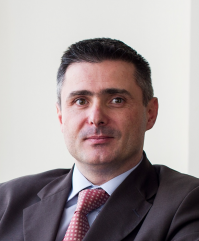
We met with Mr Vladimir Oprescu, Regional Sales Manager at AB Energy for Romania and Bulgaria, in order to discuss the developments of biomass and biogas solutions in Bulgaria and Romania. The interview is also published in the Bulgarian Utilities Magazine.
_____
Mr. Oprescu, what are the main products and services, offered by AB Energy?
AB Energy was started more than 30 years ago by Angelo Baronchelli, who gives the abbreviation “AB” in the name of the company. At the beginning, he started to develop a solution for electrical parts, which are necessary in the sector of renewable energy.
Then, in 1990 he started collaboration with a very big Austrian company, which specializes in the production of gas engines – Jenbacher. This company created engines dedicated to working with different types of gases. They did not modify diesel engines, but designed from the beginning such engines.
In 1991 the first high-efficiency cogeneration plant on natural gas was installed. In 1992 we installed the first biogas plant and in this moment we have installed more than 900 biogas plants in all countries where we are present with a total electric capacity of more than 1200 MW.
Since 2011 Gruppo AB started to develop in a more aggressive way also in other countries in Europe. In addition to Italy, we are active in Poland, Romania, Bulgaria, the Czech Republic, Croatia, Serbia, France, the Netherlands, Spain, and last year started activities in Austria, Germany, and this year – in United Kingdom. We are also already present in Canada and Brazil. In this moment, the group has more than 500 employees and more than 30 years ago it was just a family company.
Last year your company finished its first project in Bulgaria, could you present some details about it?
We commissioned the first project in Bulgaria last year in mid-June. The project is very close to Balchik and is a plant, running on biogas, obtained from anaerobic fermentation of corn silage and animal manure. The plant is delivering 1 MW of electrical energy for the grid and thermal power for other applications of the investor.
We are now developing additional projects. Till the end of June this year we have to install another three smaller plants, one with 0.9 MW electrical output and the other two – with 0.5 MW electrical output each. We are sure that until the end of the year the number of contracts will increase.
In biogas, we can build installations up to 3 MW but we are not recommending to our customers to use such big engines. It is better to use maximum 1.5 MW engines due to the fact that for large installations the quantity of the biomass needed is quite important. In case the customers could not feed the plant with enough biomass, they can keep one of the smaller engines in backup. But in the end, it is the customers’ decision.
Who are the potential users of this technology in Bulgaria?
The most interested customers are farmers, as they have animal manure, which has to be stabilized for 4-6 months before it could be used as fertilizer. With our solution, this manure can be used and it could be processed in a quicker way – for 1-1.5 months, into the best-quality natural fertilizer.
Also, agricultural companies with corn plants can be interested. In this case, however, the cost of silage is bigger. Last, but not least, the industrial sector and district heating can benefit from our solutions in natural gas. The solutions are high-efficient, because with the same amount of biomass you can get both electrical and thermal energy. The classical solutions are using natural gas to obtain thermal power – hot water or steam, but we have the possibility to generate two energy products, which is more efficient.
The RES market in Southeast Europe and throughout the EU is currently meeting some opposition. What are your expectations for the development of green energy in Europe and more specifically in Romania and Bulgaria?
It is very important to understand, that renewable energy includes solar, wind, biomass, but also biogas solutions. Solar and photovoltaic solutions were very well developed, while for biomass and biogas the market is still not mature. Probably, solutions like wind and solar will be affected by new rules. But in Romania and Bulgaria the conditions for biogas were not modified. I am sure this trend will remain because first of all, with this solution we are obtaining benefits using the waste, we are helping the environment by reducing greenhouse emissions, and this kind of solution comes with constant and predictable power production. Biogas can be very important and good solution for grid balancing. The grid operators are looking for such balancing solutions.
Romania uses green certificates for support of renewable energy, while Bulgaria has feed-in tariffs. In your view, which of the two options gives better results in the current market situation?
Definitely, from any point of view, having feed-in tariffs is better. First of all, when you go to a bank to negotiate a loan, in Romania they calculate the minimum price scenario for the green certificates, while in Bulgaria they use the value of the feed-in tariff. The latter comes with more stability.
Another important aspect is that for our customers who develop such projects it is very important to have constant revenues, because they can make plans easier – just like the banks. In my opinion, currently the Bulgarian market has larger stability from this point of view and it is a market where such kind of investment is reliable and can be counted for at least 15 years.
This year your company is participating at the EE&RES expo in Sofia for the first time. What are your expectations from this participation?
We came last year to visit the fair and after it decided to participate actively in 2014. For us, it is important to participate for many reasons: we want to understand better the Bulgarian market and the requests from the Bulgarian market. In our philosophy is not to come with standard products, but to adapt our products for each project.
Second, it is also a matter of being promoted on the Bulgarian market with such a participation in a fair. We had meetings with potential customers and local organizations. Now they know that we are present in the market and after the fair we can organize direct meetings and explain in details our products and services for each business.
 All interviews
 Interview
 Full text
 Events


