

|

|

Sign up for our newsletter to receive the latest news and information from publics.bg


News
From Bulgaria


 24.01.2014 16:29
© Bulgarian Ministry of Economy and Energy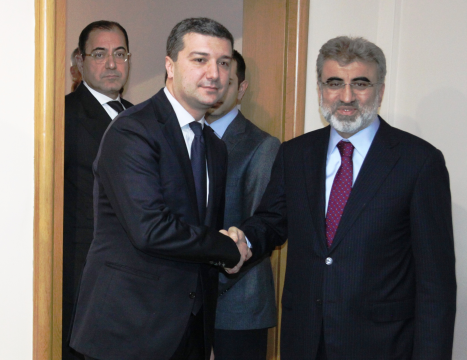
Sofia and Ankara announced a broad-range energy partnership poised to bring new economic opportunities for Bulgaria and Turkey. A firm decision, with particular parameters and deadlines, has been taken for the construction of a gas interconnector between the two countries, it became clear following today’s meeting between Bulgarian energy minister Dragomir Stoinev and his Turkish counterpart Taner Yildiz in Sofia.
“This project is a great success for our bilateral relations. I believe it is one of the factors that will warrant natural gas supply diversification and security”, minister Stoinev stated.
“Energy will help the economic development of our countries and will offer us new opportunities”, minister Yildiz affirmed.
Bulgartransgaz will construct the Bulgarian part of the interconnector
Minister Stoinev revealed a few details regarding the project as seen by the Bulgarian government. He stated that the construction agreement should be signed in March. Construction should be concluded within two years.
“We decided that the state-owned gas network operator should construct the Bulgarian part of the interconnector”, Stoinev affirmed. Earlier reports of Bulgartransgaz showed that the pipeline to the Bulgarian-Turkish border will be about 75-km long.
Both ministers however declined to comment on the price of the project, as it will depend on the technical assessment yet to be carried out.
Turkey will have to expropriate lands along a 114-km long route, which will add to other expenses and then allow us state the price, minister Yildiz said. Turkish gas company BOTAS was among the possible contractors.
Joint-venture for electricity export
Bulgaria’s state-owned National Electricity Company (NEK) will form a joint-venture with a yet unnamed Turkish counterpart. The new joint-venture will be based in Turkey and will help boost direct electricity export from Bulgaria to Turkey.
Minister Stoinev saw this as one of the main ways to stabilise financially NEK, which has accumulated about BGN 2.3 billion (about EUR 1.15 billion) in debts to electricity producers and credit institutions.
Minister Yildiz stipulated that after the creation of the joint-venture there is a possibility for raising electricity exports from Bulgaria to Turkey to as much as 1300 MW. Current data of Bulgaria’s Electricity System Operator (ESO) show that the prognosis-based export limit is 366 MW.
Nuclear cooperation ahead
Minister Yildiz stated that Turkey is interested in profiting from Bulgaria’s experience, technical ability and serious human resources in the field of nuclear energy.
“Kozloduy nuclear station has a respectable experience and a number of specialists – a potential that Turkey has not yet achieved, given that the country is making its first steps in nuclear energy”, Yildiz said.
Turkey has recently signed a deal with Japan’s Mitsubishi Heavy Industries a nuclear power plant near Sinop. Another NPP should be underway as soon as 2015 at Mersin, built by Russia’s Rosatom.
Yildiz declined to comment whether Turkey has plans to build a new gas or nuclear unit at Igneada, close to the Bulgarian border, as the future of the site was yet undecided.
“We care for both the people of Turkey and Bulgaria and I believe nuclear safety is our foremost concern. We should build secure nuclear facilities”, Yildiz explained.
South Stream is of mutual importance
Both ministers stated their support for the gas pipeline project South Stream. Yildiz described it as a crucial gas route not only for Bulgaria and Turkey, but also for the Balkan region and Europe.
 All news from Bulgaria
 Interview
 Full text
 Events


